Virus & Spyware Protection: 72%
AVG's overall virus and malware protection performed well in some of our tests but missed the mark in others.
For our first set of tests, we heavily infected our testing PCs with a host of malware, including trojans, viruses, rogueware, etc, then ran a full-system scan with AVG AntiVirus 2016.
AVG did a good job, detecting and removing the majority of embedded threats. Unfortunately, our browsers were still hijacked by foreign adware, and there were still a lot of leftover desktop icons, despite their being rendered inactive by AVG, leaving the impression that malware remained even though all that was left were the harmless icons.
When we looked for any malware lurking in the background, consistently we found nothing, which was impressive.
AVG's real-time protection fared well, too. For our tests, we installed a clean and updated version of AVG, then tried to download and install a wide array of malware samples.
Malware files were instantly blocked or flagged for removal by AVG. The adware that did get through was cleaned up after a reboot, when nearly everything was removed leaving our testing PCs good as new.
Now for the concerning point: antiphishing. During our tests, we sampled a wide range of live, active phishing sites to see how well an antivirus software will do. AVG didn't block any of them. Not one.
In fact, we thought this had to be an error, and double- and triple- checked on different test PCs to make sure AVG was configured correctly. It was. AVG just failed to detect or block any phishing sites.
We even went one step further and tested some older phishing links that all antivirus software should easily detect. Not AVG AntiVirus. Failed again.
So, while we're happy to see antiphishing included in a basic antivirus software, and normally we'd award bonus points for having it, in this case we have to remove points because of the false sense of security given.
Resource Usage: 82%
Last year AVG was the champ in the resource use department. This year, AVG uses a more than it did last year and in fact more than some competition. On balance it's still within acceptable range.
When running idle, AVG ran nearly silent in the background. When running a full-system scan, AVG used about 14% of our computer resources on average. It may be a bit higher than we'd like to see, especially from the reigning champ of resource use, but it's still acceptable.
Boot-up time was a few seconds slower than the competition but shouldn't pose a problem for most people.
User Interface: 89%
AVG's user interface is easy enough to use. Green and red colors clearly indicate which sections are active and protected, and which are not.
Each major section is clearly identified with easy to read buttons for easy access.
There are a decent number of advanced options for more detailed control for those who need it, and they do a fairly good job of presenting the options without making them overwhelming.
Overall, it's a well-executed interface. McAfee would be well-served to study AVG's interface.
Sunday, June 5, 2016
Thursday, June 2, 2016
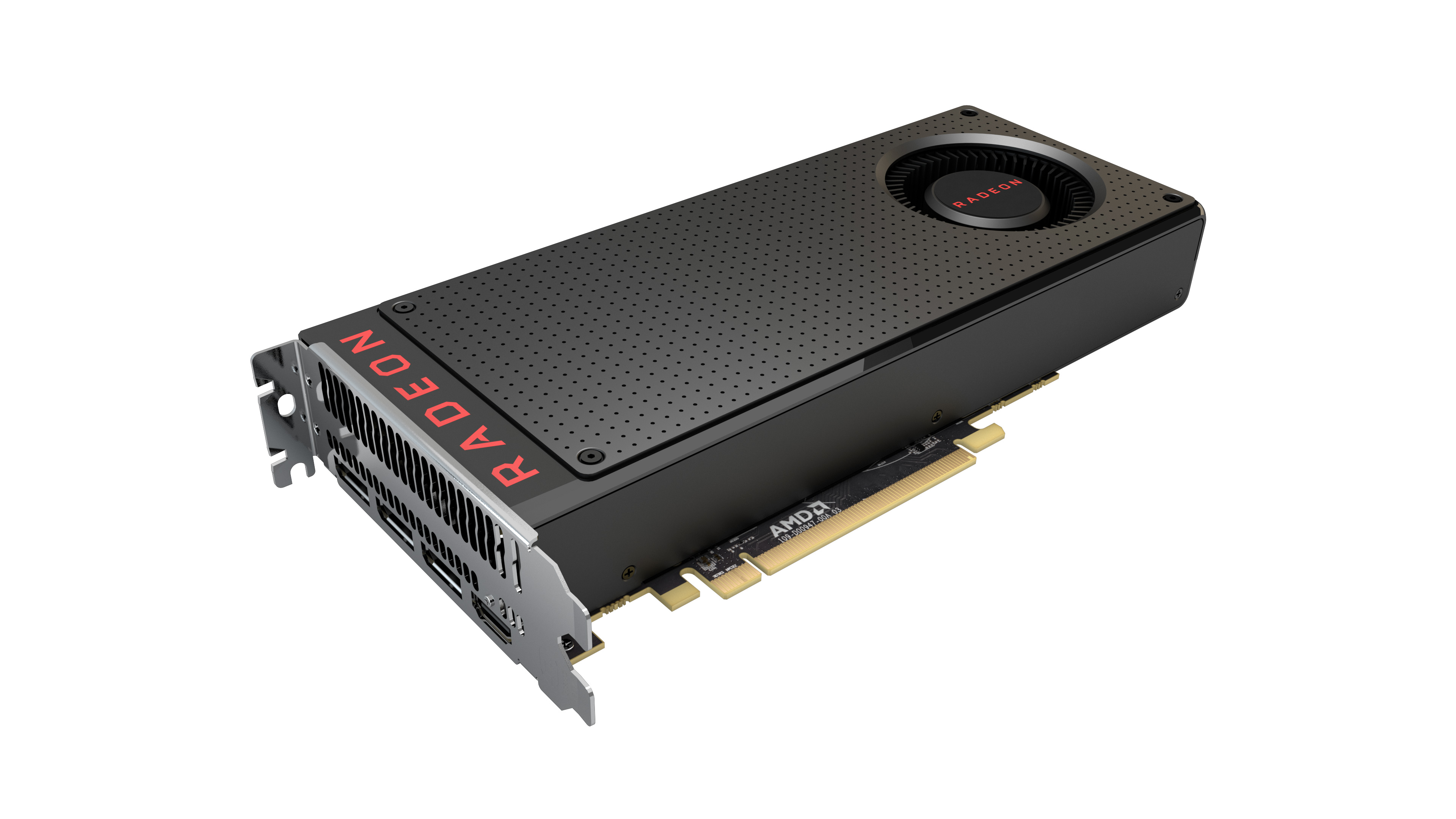
AMD Teases Radeon RX 480: Launching June 29th For $199
Kicking off at this moment is AMD’s Computex 2016 keynote. The company has multiple announcements scheduled this evening, but we’re going to jump right into an area that has been of extreme interest for many of our readers: GPUs.
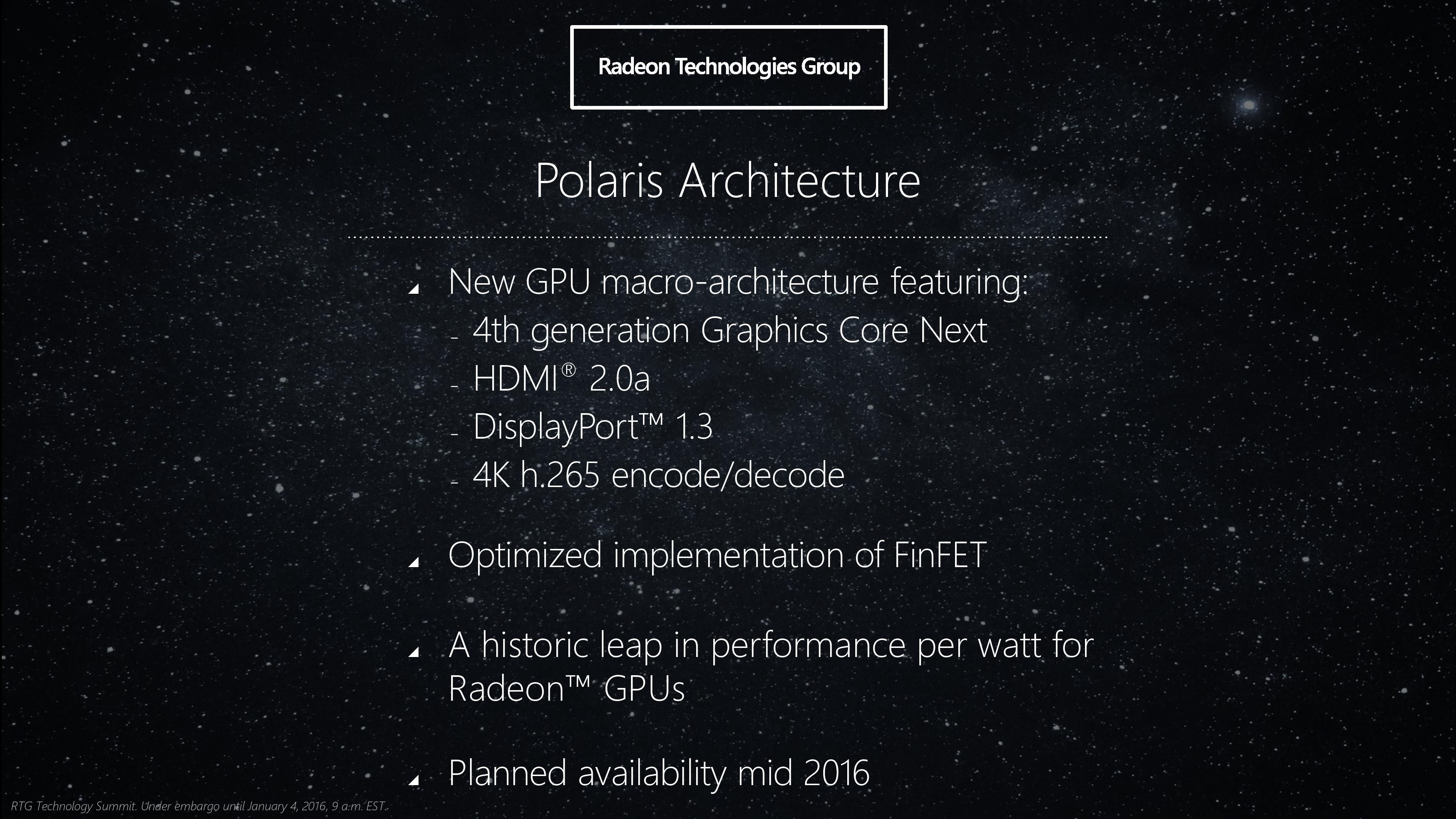
Ahead of this evening’s event, AMD sent out an email to the press teasing the first of their discrete Polaris architecture based cards. Called the Radeon RX 480, AMD has unveiled much of the product’s specifications, but also its price and availability. When the card hits the streets on June 29th, it will be starting at the crucial mainstream battleground price point of $199.
First off, the RX 480 will include 36 CUs. If we assume 64 stream processors to a CU – the GCN standard – then this brings us to 2304 SPs. AMD has not named the specific Polaris GPU being used here, but given the CU count I believe it’s reasonable to assume that this is a Polaris 10 SKU, as I’ve already seen Polaris 11 and it’s a very small chip better suited for notebooks.
AMD also revealed that the card would offer over 5 TFLOPs of compute performance. Given what we know about the CU count, this allows us to estimate the GPU clockspeed. This puts the lower bound of the GPU clockspeed at 1.08GHz and an upper bound (6 TFLOPs) at 1.3GHz, which would be in the range of 10-30% higher clocked than comparable Radeon 300 series cards.
In terms of raw numbers this puts the RX 480 just shy of the current Radeon R9 390. However it also doesn’t take into account the fact that one of the major focuses for Polaris will be in improving architectural efficiency. I would certainly expect that even at the lower end of clockspeed estimates, RX 480 could pull ahead of the R9 390, in which case we’re looking at a part that would deliver performance between the R9 390 and R9 390X, with final clockspeeds and architectural efficiency settling just how close to R9 390X the new card gets.
On the memory front the card is equipped with 8Gbps GDDR5, running along a 256-bit memory bus. This is the typical bus width for AMD x80-series cards, and the high clocked 8Gbps GDDR5 means that we’re looking at a total of 256GB/sec of memory bandwidth to feed the RX 480’s GPU. AMD’s partners will be offering both 4GB and 8GB cards, and for the purposes of this teaser I assume that pricing information will be for the 4GB card, with 8GB serving as a premium option.
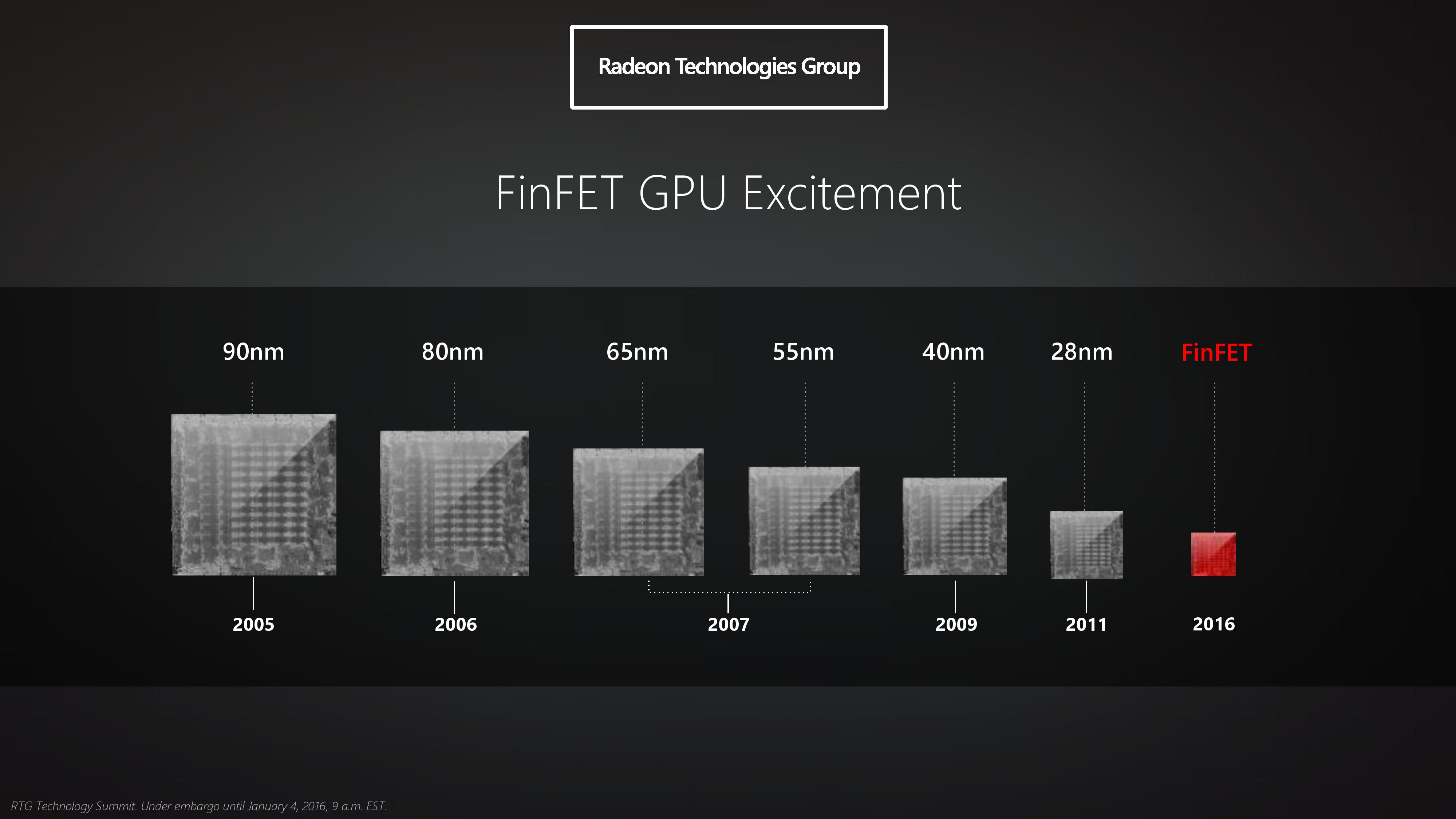
Finally, AMD has also revealed the TDP for the RX 480, stating that it will be a 150W card. As Polaris is built on 14nm FinFET, we’re seeing first-hand the benefits of finally making the long-awaited jump off of 28nm, as this means we’re looking at Radeon R9 390 series performance in a card that, on paper, consumes only a bit more than half the power. This also puts the RX 480 right in the sweet spot for mainstream cards, as 150W has traditionally struck a good balance between performance and power consumption that allows for a fast card that doesn’t require aggressive cooling, and is more compatible with OEM computer vendor case & cooling designs.
Cementing its place as a mainstream card, the RX 480 pricing will start at $199. This is an aggressive and heavily fought over price point that has traditionally defined the mainstream segment, attracting buyers who want great 1080p gaming performance that sub-$150 value cards can’t offer, without moving up to more expensive (and power hungry) $300+ cards. In this sense the RX 480 is a direct replacement for the R9 380, AMD’s Tonga-based card that hit the market roughly a year ago at the same price. Going by the raw numbers alone, RX 480 would be 40% (or more) faster than the R9 380.
Meanwhile I won’t speculate too much on the competitive market from a teaser, but it’s worth noting that this is nearly half the price of NVIDIA’s currently cheapest Pascal card, the GeForce GTX 1070. Interestingly both cards have the same 150W TDP, but looking at the throughput figures it does not look like RX 480 is meant to offer quite as high performance as NVIDIA’s card.
What’s New in the Latest Windows 10 Insider Preview
Windows 10’s next big update, dubbed the “Anniversary Update”, comes out this summer. Here’s what’s been announced so far, along with a few goodies we’ve discovered in the first, second, third, and fourth Insider Preview builds.
While Microsoft hasn’t officially announced a release date, a roadmap on Microsoft’s website promises these new features for “July 2016.” We’re guessing it’ll be released on July 29, 2016, which is the one-year anniversary of Windows 10’s release.
This post was originally written on March 30, 2016, but has since been updated with features from the Insider Previews–the latest being build 14352.
Cortana Becomes a Whole Lot Smarter
Arguably the biggest update is Cortana. Microsoft continues to expand on what Cortana can do, clearly trying to make it the most powerful assistant in an increasingly growing pool of competition (Siri, Google Now, Alexa, and the whole gang). This time around, Cortana comes to the Windows 10 lock screen, so you can invoke her at any time. And, she can push stuff to and from your mobile device, including notifications and text messages. (And remember, sinceCortana is available on Android too, that doesn’t mean you need a Windows Phone to take advantage.)
More interestingly, though, Cortana can parse even more information about stuff it thinks you might need. For example, the on-stage demo showed us that Cortana can respond to things like “Send Chuck the PowerPoint I worked on last night”, or “What toy store did I visit at Build last year?” That’s pretty crazy. Of course, if you’re more privacy-conscious, that’s crazy in all the wrong ways–but it’s a pretty tempting set of features.
Cortana can also make proactive suggestions for you. If you receive email confirmation of flight details, it’ll add them to your calendar. If you promised Chuck you’d send him that PowerPoint in an email, Cortana will know, and remind you to fulfill that commitment later on.
Furthermore, if you add an appointment to your calendar, it’ll know if that appointment overlaps with another, and ask you if you want to re-schedule one of the overlapping events. Or, if you have a meeting during lunch it’ll ask if you want to book a table, or make a to-go order, based on the apps you have available. In short, Cortana is getting more proactive, so you don’t have to be on top of your own stuff–and isn’t that what having an assistant is all about?
Windows 10 Interacts with Your Android Phone (or Windows Phone)
This isn’t finished in the Insider Preview yet, but after the Build keynote, Microsoft also announced that Cortana will now integrate with the Cortana application on your Android or Windows smartphone. You’ll just need to install the Cortana Android app and sign in with the same Microsoft account on both devices. iPhone users are out of luck, as iOS is too locked down for Microsoft to integrate with it as deeply. As of build 14328, this should be working between Windows 10 PCs and Windows Mobile 10 phones running the latest builds. It now works between Android phones and Windows 10 PCs, too–just be sure you have the latest Cortana app installed from Google Play.
Cortana can mirror all your Android phone’s notifications to your PC, giving you all your notifications in Windows 10’s Action Center. You’ll also see a notification on your PC when your smartphone has low battery power, so you’ll know when to charge it. Cortana will offer a “find my phone” feature that can remotely geolocate your phone on a map or ring it if you lose it in nearby. Ask Cortana for “directions to [place]” on your PC, and you’ll see those same directions on your phone. These are just the current features, too, so you can expect Microsoft to add more.
Cortana will also support something called “Messaging Everywhere,” although it wasn’t yet enabled when build 14316 was released. Receive an SMS message on your phone and it’ll pop up on your Windows 10 PC. You can respond from your computer and the message will be sent through your phone. The various features are already integrated into the Messaging app on Windows 10.
More Desktop Apps and Games Come to the Windows Store
The Windows Store is caught in a tough place right now. We want it to get more desktop apps and games, but we don’t want them limited by the Universal Windows Platform (UWP). Microsoft is trying to fix that disconnect in the Anniversary Update.
Regular desktop apps are finally coming to the Windows Store–at least, as long as developers “convert” them to the UWP. This allows for the easy discovery and installation of the Windows Store, but supposedly comes without all the limitations UWP apps traditionally have. We still aren’t quite sure what this means, and which apps might be candidates for a clean conversion without limitations, but it’s an intriguing proposition.
Microsoft will soon release a tool that allows anyone to convert any desktop application on their computer to a sandboxed UWP application. The tool will watch the desktop application run and create a sandboxed application with the appropriate permissions. Developers can use this to convert their own apps for uploading to the Windows Store. You could use it to convert an old desktop application to a UWP application and sideload the application, installing it from outside the Store, if you wanted to.
Games are a big part of this. We’ve already seen that games bought from the Windows Store are missing certain features, like SLI and crossfire support, or the ability to toggle Vsync and borderless full screen. Microsoft says they’re addressing these issues, adding the ability to disable Vsync, better support for multiple GPUs, and more–including support for modding, overlays, and G-Sync and Freesync. That’s in addition to the UWP-exclusive features they have, like live tile support and notifications. Microsoft also says they’ll soon support bundles and season passes in the Windows Store. But only time will tell if games get feature parity with their regular desktop counterparts.
Windows 10 Gets a Dark Theme (and More Theme Options)
When Windows 10 was released, it included a hidden dark theme you could enable by changing a registry setting or by pressing a secret keyboard shortcut in the Store app. You could also change your theme in the Edge browser–but just for Edge. This theme was incomplete. With the Anniversary Update, you can now choose between light and dark modes in Settings > Personalization > Colors. Its designed for Windows Store apps, but not every app will listen to this setting and obey it–some apps, especially those from third-party developers, control their own theme settings. This also means File Explorer will remain as blindingly white as ever.
There’s also now a separate “Show color on title bar” option here, allowing you to only apply your color of choice to the window titlebars and continue using a black Start menu, taskbar, and action center.
Microsoft Edge Finally Supports Browser Extensions
Microsoft Edge was originally supposed to launch with browser extensions when Windows 10 was released, but it didn’t happen. This is a big reason MIcrosoft Edge felt so half-baked and lost so many users. With the Anniversary Update, Edge will finally support browser extensions.
Edge uses Chrome-style extensions, and Microsoft will provide a tool that helps developers quickly convert Chrome extensions to Edge extensions. (Firefox is also moving to Chrome-style extensions, too.) These Edge extensions are already available in the Windows Store, which is where you’ll install them. Extensions are currently available for the Reddit Enhancement Suite, Microsoft Translator, Pinterest, OneNote, Adblock, Adblock Plus, and LastPass.
Edge Gets Click-to-Play Flash, Pinned Tabs, Web Notifications, and Swipe Navigation
Setting the Flash plug-in to click-to-play can help you avoid Flash’s security holes and battery-draining behavior. Edge currently doesn’t offer much control over Flash, with only a single browser-wide “Use Adobe Flash Player” option in its settings.
Microsoft has announced that, with the Anniversary Update, Edge will automatically pause Flash content that isn’t integral to the page and you’ll have to click it to play. Games and videos on web pages should work normally, but Flash advertisements won’t automatically play. Google Chrome already made this change, so Edge is following in Chrome’s footsteps here, too. This isn’t in the Insider Preview just yet, but hopefully it will be soon.
Saturday, April 16, 2016
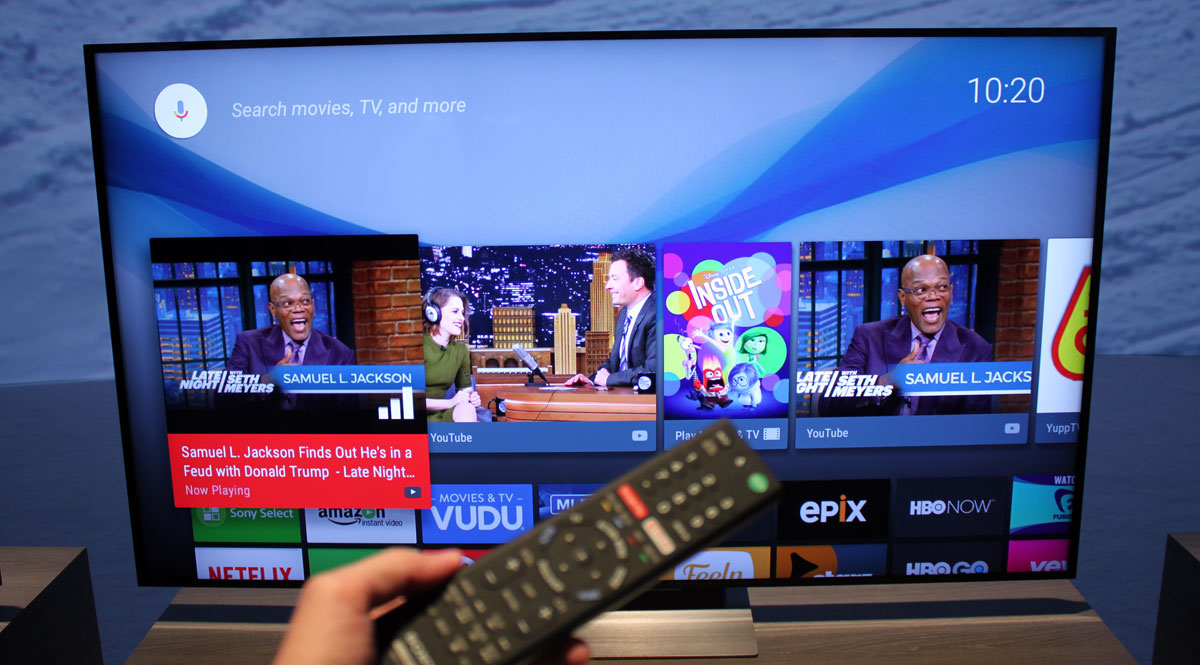
Android TV 6.0 is rolling out soon - here's what we know
TVs and media players with Android TV are currently running version 5.1. The 6.0 update will improve stability / performance, introduce a revamped voice search function, and add some new features. It will start rolling out soon.

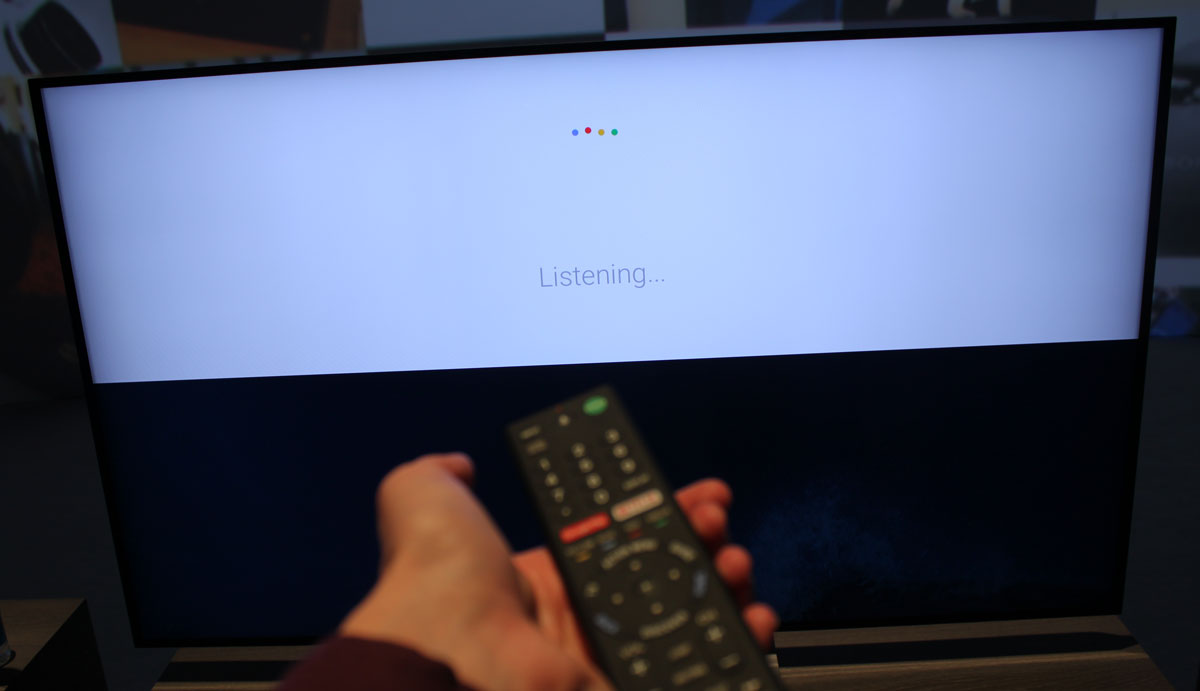
There was no doubt that the 2016 Sony TVs at CES were based on an updated version of Android TV that felt snappier and more reliable than the current 5.1 version. An improved voice search function offered better voice recognition (even in the loud CES halls) and appeared to react much faster. The voice search UI will get a refreshed look. The Google Play store also has a new, fresh look, and Google will furthermore introduce a “Child mode”.
We were informed by sources that the Sony TVs did indeed run a 6.0 preview version of Android TV. We also heard that Google’s main focus with Android TV 6.0 has been to improve stability and performance, to fix security holes, and to fix bugs, instead of adding major new features.
Remember that manufacturers are not allowed to change the user interface of Android TV.

At CES, Nvidia confirmed that their Shield media player will get an update to 6.0 Marshmallow “very soon”. The company also confirmed a few new features, saying that the update will add “Adoptable Storage, which helps you super-size your storage capabilities. When adding an SD card, USB drive or external hard drive, Shield Android TV can recognize the new storage as internal memory”.
Nvidia added that the update will simplify the startup process so there “are even fewer steps you need to take before launching your favorite apps, movies, music and games”. You can say "OK Google, set up my device" to your phone/tablet and it will automate the process of setting up your new TV. It will even transfer over your WiFi passwords.
It will be possible to take control of the top Recommendations row and select which apps are allowed to push content. The other rows (apps and games) can be re-organized.
Based on what we have heard, we believe that the 6.0 update will start rolling out around March-May, depending on your device.
UltraFlix offers a library of 600 hours of 4K content, although heavily compressed and much of it has been upscaled from HD. Recently, HBO Now, Showtime, and Twitch were added. Two game streaming services, Gamefly and Gametree, will be introduced soon.
In the gaming category Metal Gear Rising: Revengeance will come to Shield.
TCL confirmed to us that it will introduce the first TVs with Android TV this autumn, possibly at IFA 2016 in Berlin. TCL also told us that they are waiting for the 6.0 update. This makes sense as Google has likely agreed to give its early partners at least one year of exclusivity.
Android TV version 6.0
Oddly, none of the manufacturers at CES wanted to confirm when the 6.0 Marshmallow update is coming. Sony - the largest manufacturer of Android TVs - did not even want to confirm whether the 2016 TVs on display at CES 2016 ran 6.0 or not, and had nothing to say regarding new hardware either. However, Sony did confirm that 6.0 is coming to both its 2016 and 2015 TVs. Sony also told us that the 2016 TVs will support YouTube in HDR.There was no doubt that the 2016 Sony TVs at CES were based on an updated version of Android TV that felt snappier and more reliable than the current 5.1 version. An improved voice search function offered better voice recognition (even in the loud CES halls) and appeared to react much faster. The voice search UI will get a refreshed look. The Google Play store also has a new, fresh look, and Google will furthermore introduce a “Child mode”.
We were informed by sources that the Sony TVs did indeed run a 6.0 preview version of Android TV. We also heard that Google’s main focus with Android TV 6.0 has been to improve stability and performance, to fix security holes, and to fix bugs, instead of adding major new features.
Remember that manufacturers are not allowed to change the user interface of Android TV.
At CES, Nvidia confirmed that their Shield media player will get an update to 6.0 Marshmallow “very soon”. The company also confirmed a few new features, saying that the update will add “Adoptable Storage, which helps you super-size your storage capabilities. When adding an SD card, USB drive or external hard drive, Shield Android TV can recognize the new storage as internal memory”.
Nvidia added that the update will simplify the startup process so there “are even fewer steps you need to take before launching your favorite apps, movies, music and games”. You can say "OK Google, set up my device" to your phone/tablet and it will automate the process of setting up your new TV. It will even transfer over your WiFi passwords.
It will be possible to take control of the top Recommendations row and select which apps are allowed to push content. The other rows (apps and games) can be re-organized.
Based on what we have heard, we believe that the 6.0 update will start rolling out around March-May, depending on your device.
New apps and games
Apps and games are being added to the Google Play store on Android TV all the time but a few notable additions have just been added or will be added later in 2016.UltraFlix offers a library of 600 hours of 4K content, although heavily compressed and much of it has been upscaled from HD. Recently, HBO Now, Showtime, and Twitch were added. Two game streaming services, Gamefly and Gametree, will be introduced soon.
In the gaming category Metal Gear Rising: Revengeance will come to Shield.
New Android TV partners
Hisense, TCL, Bang & Olufsen, Vestel, Arcelik (Grundig), and RCA have all signed on as Android TV partners, Google confirmed at CES. Only RCA had a TV on display.TCL confirmed to us that it will introduce the first TVs with Android TV this autumn, possibly at IFA 2016 in Berlin. TCL also told us that they are waiting for the 6.0 update. This makes sense as Google has likely agreed to give its early partners at least one year of exclusivity.
LG unveils 2016 OLED TVs with 4K, HDR, Dolby Vision, more
At CES 2016, LG unveiled its new 2016 OLED TVs that will consists of four models under a new Signature brand and four cheaper models. They are incredible thin and elegant, and will deliver the ultimate picture quality with deep OLED blacks, UHD Premium certification, HDR support (including HDR10 and Dolby Vision), and more.

The new OLED TVs look stunning. They are so thin that LG calls it “picture-on-glass design”. The thinnest OLED model measures just 2,57 mm in thickness, which is as thin as four credit cards.
LG will launch four new 2016 OLED TVs under the Signature brand; the so-called G6 and E6 series. Details on the specific models are scarce at this point but we are chasing more information. E6 is a series of flat 55” (OLED55E6) and 65” (OLED65E6) TVs and G6 is a series of flat 65” (OLED65G6) and 77” (OLED77G6) TVs.
LG will also launch four cheaper OLED TVs with 4K and HDR. Details on these TVs have yet to be released.

The new OLED TVs are “UHD Premium” certified, meaning that they meet the highest requirements for picture quality, including 4K HDR. To receive the certification the TVs will need to have a peak brightness of at least 540 nits and a DCI-P3 color gamut of at least 90% - but of course you already knew that they would.
LG used the event to remind people that HDR (high dynamic range) is about more than just peak brightness. It says that its OLED TVs can reproduce over 20 stops of brightness compared to just 12 for the best LCD TVs. That is why they are calling them “HDR Pro”. The OLED TV use true 10-bit processing and supports BT.2020 (although the actual color gamut is smaller, 99% DCI P3).

Sound has been developed in collaboration with Harman Kardon. The soundbars, equipped with extra woofers underneath the TVs should be able to deliver a better sound experience than regular integrated speakers.
LG’s OLED TVs will support several HDR formats, including HDR10. Dolby was on stage at CES 2016 to announce that the OLED TVs will support the Dolby Vision format. LG will collaborate with several partners to bring HDR to its TVs through its webOS 3.0 platform, including Amazon, Netflix, YouTube, BBC, and others.
LG's 2016 OLED TV will launch in March. We are chasing more details.
LG’s 2016 OLED TVs
With the launch of the new OLED TVs, LG is introducing a new high-end Signature brand. The Signature products have been designed by Torsten Valeur, and the idea is to create simple and minimalistic products that are simple and intuitive to use.The new OLED TVs look stunning. They are so thin that LG calls it “picture-on-glass design”. The thinnest OLED model measures just 2,57 mm in thickness, which is as thin as four credit cards.
LG will launch four new 2016 OLED TVs under the Signature brand; the so-called G6 and E6 series. Details on the specific models are scarce at this point but we are chasing more information. E6 is a series of flat 55” (OLED55E6) and 65” (OLED65E6) TVs and G6 is a series of flat 65” (OLED65G6) and 77” (OLED77G6) TVs.
LG will also launch four cheaper OLED TVs with 4K and HDR. Details on these TVs have yet to be released.
The new OLED TVs are “UHD Premium” certified, meaning that they meet the highest requirements for picture quality, including 4K HDR. To receive the certification the TVs will need to have a peak brightness of at least 540 nits and a DCI-P3 color gamut of at least 90% - but of course you already knew that they would.
LG used the event to remind people that HDR (high dynamic range) is about more than just peak brightness. It says that its OLED TVs can reproduce over 20 stops of brightness compared to just 12 for the best LCD TVs. That is why they are calling them “HDR Pro”. The OLED TV use true 10-bit processing and supports BT.2020 (although the actual color gamut is smaller, 99% DCI P3).
Sound has been developed in collaboration with Harman Kardon. The soundbars, equipped with extra woofers underneath the TVs should be able to deliver a better sound experience than regular integrated speakers.
LG’s OLED TVs will support several HDR formats, including HDR10. Dolby was on stage at CES 2016 to announce that the OLED TVs will support the Dolby Vision format. LG will collaborate with several partners to bring HDR to its TVs through its webOS 3.0 platform, including Amazon, Netflix, YouTube, BBC, and others.
LG's 2016 OLED TV will launch in March. We are chasing more details.
Thursday, November 12, 2015
HDR TVs explained
What comes after Ultra HD? Most people in the industry would say high dynamic range (HDR) and point out that it is a much bigger step forward in picture quality than Ultra HD resolution. But what is HDR exactly and why is it so important? We explain what HDR on TVs is all about, and explain why it about to lay a completely reimagined and important foundation for the future of displays.
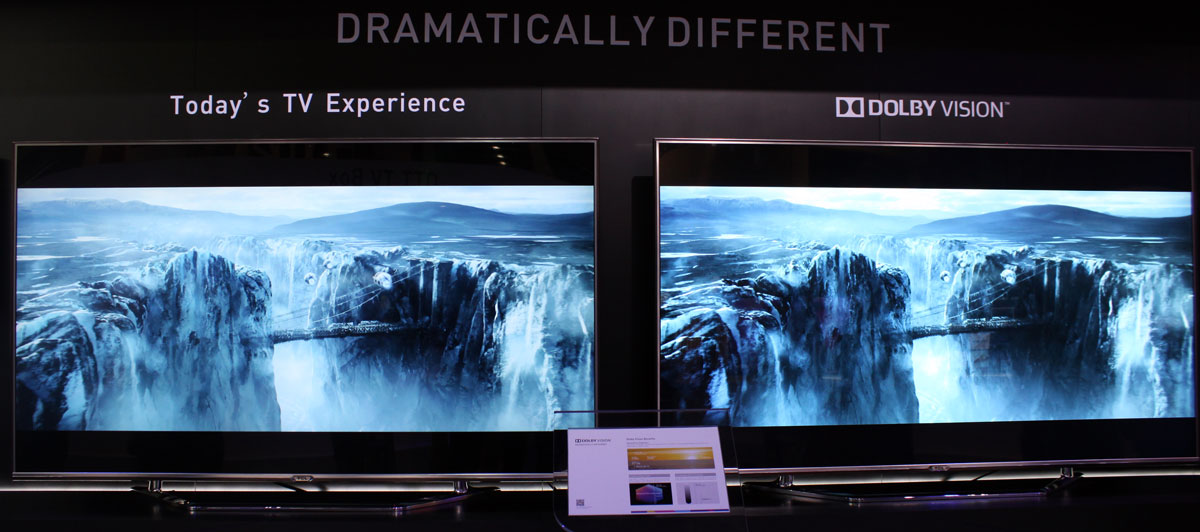
HDR is short for high dynamic range, which implies that you are currently watching standard dynamic range. It is impossible to show you what it looks like – your monitor is not capable of HDR – but consider the simulated photo below (from Dolby). HDR on the right side.
In essence, HDR is about brighter whites and deeper blacks, and more details in each end. HDR is about reproducing the world around us on a display. Current displays are not capable of reproducing the world as it really is because the world is more than just pixels. Light is just as important. That might sound confusing but we will get back to that.
Imagine being able to see bright sunlight reflections on metallic surfaces or all the stars in the sky on a perfect black canvas, even have your TV reproduce the colors of the worlds around you such as Coca Cola red (your current TV cannot reproduce this color).
There is quite a bit of confusion around HDR and for good reason. There are several players in the industry that are trying to make HDR happen, and you might already have heard about Dolby Vision. There is also an open HDR standard that has been adopted by Blu-ray and other distribution channels. TV manufacturers have come up with even more names.
For example, Samsung calls its HDR-capable TVs “SUHD” and refer to the system that enables it “Peak illuminator”. Panasonic refers to it simply as HDR but calls a panel that supports it “Super Bright Panel”. Sony refers to it as HDR and to be sure you should look for “X-tended Dynamic Range” in the specifications sheet. All of this is just marketing. Other players such as Dolby are talking about Dolby Vision, which actually has more elements to it than just HDR.
However, the standards are almost in place and we can now start talking about how the market will approach HDR.
Let’s take a few steps back and look at HDR from a more fundamental level. The next section is quite technical but you don’t have to understand every nuance. We will repeat the important things later.
Today’s TVs use an EOTF (Electro-optical Transfer Function) method to convert an input signal into visible light (and subsequently an image), and this system still relies on the characteristics of analog CRT displays, the so-called gamma curve. This is why displays use a gamma function (typically 2.2 or 2.4). We often refer to this gamma curve in our reviews.
However, today’s LCD and OLED display technologies are capable of more than CRT, and with HDR it looks like we will finally develop display standards that are based on the characteristics of the human eye instead of the limitations of an old analog display technology.
Before we get to that consider the following. Movies and TV shows are created and graded based on these principles that assume a maximum brightness level (white) of around 80-120 nits (or cd/m2) and a minimum (black depth) of around 0.05 cd/m2 for living room TVs (around maximum 48 nits for cinema). Absolute black is zero and the best consumer displays such as OLED can reach that. Modern TVs can also go way beyond 80-120 nits for maximum brightness, which means that most TV manufacturers have tried to “enhance” the picture in numerous ways, not unlike how TV manufacturers try to “enhance” motion. The content creators hate it but the point is that our displays are capable of more than the standards allow.
Unfortunately, most people associate “high brightness” on displays with bad things due to how TV manufacturers have approached it in the past. We often hear questions like “is HDR kind of like the dynamic mode on my TV”? Forget those thoughts for now and consider that a typical day with thin clouds equals something like 4000-7000 nits and a sunny day has an ambient light level of over 30,000 nits. Direct sunlight is even more extreme. We obviously don’t want to have to wear sunglasses in front of our TV but if we want to recreate the real world on a display there is no other way; we need higher brightness. Also, remember that the human eye dynamically adapts to light in our environment by closing and opening the pupil. That is how the human vision dynamically adjusts to daytime and night time.
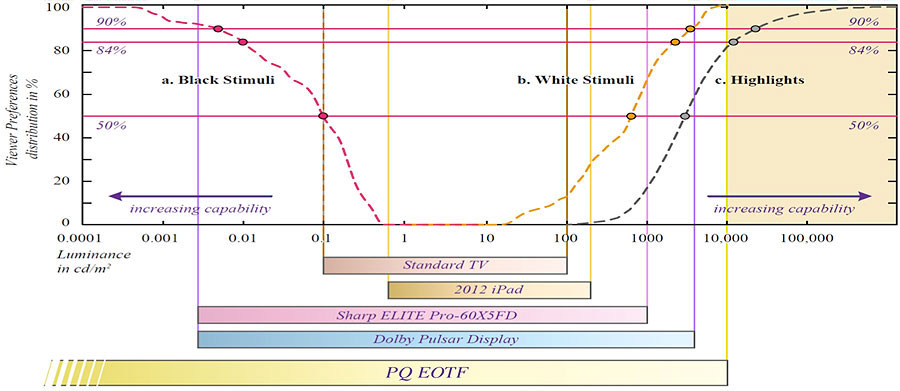
So how much brightness do we need? That is a subject for debate. Dolby believes that we need a dynamic range of 0 to 10,000 nits, even though its Dolby Vision format usually has a lower maximum. The Blu-ray association recommends that “over 1000 nits should be limited to specular highlights”. Below you see the results of Dolby’s research.
The challenge is that our current EOTF gamma method cannot accommodate that. We need a new EOTF method, a new way of converting a digital signal into visible light, a method that takes the dynamic nature of the human vision into account. This method has been dubbed “Perceptual Quantizer” or PQ by Dolby. It is a completely new way of defining light in a digital display, and it allows us to finally leave the analog legacy behind. It is necessary for high dynamic range, which again is necessary if we want to improve picture quality.
These principles have been adopted in the “SMPTE 2048” standard, which sometimes refer to the format as HDR EOTF or PQ EOTF. Another standard called “SMPTE 2086” describes how to input HDR signals into HDR and non-HDR TVs. It obviously follows that a HDR TV needs to support the PQ format. The content/distribution system needs to support it, too.
To make it possible we also need more options to define “steps”, or grey tones. Dolby says that we need 12-bit per channel (36 bit total) whereas the rest of the industry seems to think that 10-bit per channel (30-bit) is enough for now. As you probably know, today’s TVs typically use 8-bit per channel. If we really, really wanted to use the old EOTF gamma, developed for analog CRTs, we would need something like 14 or even 16-bit for HDR. That is impossible and unpractical. HDR EOTF makes better use of the available bits.
If you want to learn more see SMPTE’s video on YouTube.
HDR is helping to lay a new foundation for digital video systems. That alone should be enough to love it, right?
Today’s TVs use the so-called BT.709 color gamut, which can reproduce only around 35% of the colors that the human eye can perceive. The first HDR-enabled TVs are capable of reproducing most of the DCI P3 color space that cinemas use. DCI P3 covers approximately 54% of the colors we can see. But the industry has proposed a new far more ambitious BT.2020 color gamut that covers almost 76%!
The same can be said for 4K Ultra HD resolution. HDR works with HD resolution, sure, but no one seems interested in making it happen, so usually when you hear “HDR” it will imply HDR in 4K resolution.
As said, these things are not actually part of “HDR” but the industry seems to be taking the step to first DCI P3 and later BT.2020 with the introduction of HDR. And that is amazing! Full BT.2020 coverage will likely take some years to fulfill and as the name suggests it is actually a recommendation for year 2020. But the industry is moving forward and it looks like we could see the first high-end TVs with full support quite soon.
Read our backgrounder on Ultra HD & color spaces
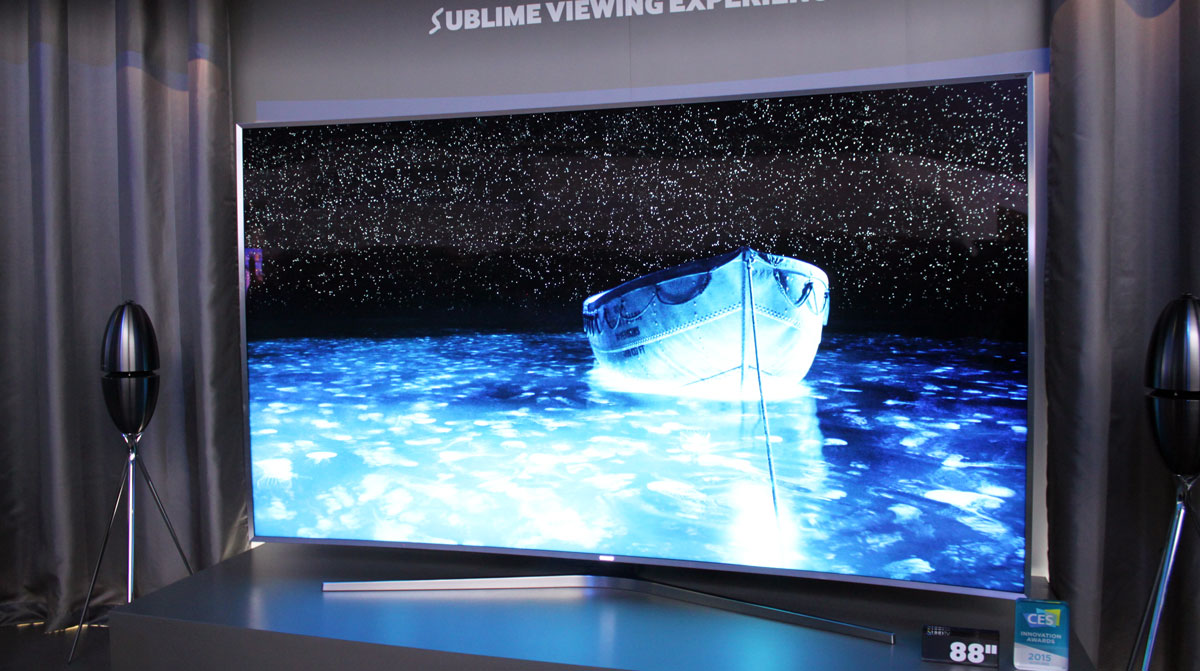
Below you see a "normal HD Blu-ray" (on top with pause logo) vs. "HDR + wider color gamut (DCI)" (on bottom without pause logo) on Samsung's "SUHD" JS9500 TV. Your current display cannot reproduce DCI or HDR so the examples are not representative but it should give you an idea. Click on the photos to zoom.
So that was the technical side of things. Let us get back to the real world again.
In order to get real HDR the industry needs to implement it in every link of the chain. The camera needs to capture HDR, studio grading needs to be done in HDR, the distribution channels need to support HDR, and your TV needs to support HDR (not just imitate it). We will focus on the last two links.
TVs obviously need to be able to output a higher brightness level but also a very low black level. Plasma TVs were not able to do that but LCDs and OLEDs are. On a LCD you will need a “local dimming” system to be able to control brightness locally in zones. The more zones the better. We have already seen edge LED based LCD TVs claim HDR support but in our opinion this is stretching it. Ideally you would want to be able to control light output from 0 nit to a maximum brightness level of 800-1000 nits (or much higher for Dolby Vision, typically 4,000-10,000) in every single pixel. Does that sound familiar? Yes that is how OLED displays work.
You will not be able to experience HDR on your current TV. You need a TV that is able to output a higher brightness level. The TV also needs to support the new PQ format, as discussed above.
TVs that claim HDR support:
Samsung JS9500, JS9000 (edge LED) and JS8500 (edge LED)
Sony 94C and X93C (edge LED)
Panasonic CX850, CX800 and CR850
LG’s 2015 OLED TVs (HDR software update coming later this year)
Vizio Reference (Dolby Vision)
These are all high-end TVs and 2015 is the first year of HDR. As always, you can expect the high-end features to appear in mid-range TVs after a year or two. There are still many issues to overcome going forward and companies such as Technicolor are trying to bring HDR to set-top boxes and TV broadcasters. As said, there are several approaches to HDR right now and besides Dolby Vision and the “open” version that is mandatory on Ultra HD Blu-ray (other formats such as Dolby Vision are optional for BD player manufacturers), Philips and Sony have been looking into it, too.
The UHD Alliance (link 1, 2) is currently trying to bring order to the industry so everyone moves in the same direction. That does not necessarily mean a single HDR specification but the UHD Alliance wants to unite efforts. Great initiative by the way.
You might be wondering what will happen if you try to play a HDR movie on a non-HDR TV. Well, the industry has actually come up with a great solution. In that case you will just get the regular SDR (standard definition range) picture. HDR is layered on top of the signal as an extra package and signaled to the TV with metadata (requires HDMI 2.0b). If the TV does not support HDR it will simply ignore the extra package.
Hollywood studios have started preparing several titles for release in 4K HDR, and the new Ultra HD Blu-ray format will obviously support it.
How to get watch HDR content:
Ultra HD Blu-ray players - starting late 2015
Netflix - will start streaming in 4K HDR later this year with a bit rate of 18 Mb/s (HEVC), possibly in more than one HDR format
Amazon Instant Video – will start streaming in 4K HDR later this year
M-Go – will offer movies in 4K HDR as a download to a secure hard drive soon, Samsung-exclusive right now
Vudu – will offer HDR movies in Dolby Vision later this year
Dolby Cinema – a new kind of cinema with Dolby Vision (HDR + more) and Dolby Atmos sound. Tomorrowland was the first title to debut on May 22.
Learn more in our 4K / HDR section
HDR is a more important development than most people realize so we suggest that you consider it for your next TV purchase. So, there you have it. Excited yet?
HDR TVs explained
You can think of HDR as the next step after 4K Ultra HD. At least that is how the industry is positioning it. 4K is “more pixels” – four times as many as HD – whereas HDR is “better pixels”. There is obviously much more to it than that.HDR is short for high dynamic range, which implies that you are currently watching standard dynamic range. It is impossible to show you what it looks like – your monitor is not capable of HDR – but consider the simulated photo below (from Dolby). HDR on the right side.
In essence, HDR is about brighter whites and deeper blacks, and more details in each end. HDR is about reproducing the world around us on a display. Current displays are not capable of reproducing the world as it really is because the world is more than just pixels. Light is just as important. That might sound confusing but we will get back to that.
Imagine being able to see bright sunlight reflections on metallic surfaces or all the stars in the sky on a perfect black canvas, even have your TV reproduce the colors of the worlds around you such as Coca Cola red (your current TV cannot reproduce this color).
There is quite a bit of confusion around HDR and for good reason. There are several players in the industry that are trying to make HDR happen, and you might already have heard about Dolby Vision. There is also an open HDR standard that has been adopted by Blu-ray and other distribution channels. TV manufacturers have come up with even more names.
For example, Samsung calls its HDR-capable TVs “SUHD” and refer to the system that enables it “Peak illuminator”. Panasonic refers to it simply as HDR but calls a panel that supports it “Super Bright Panel”. Sony refers to it as HDR and to be sure you should look for “X-tended Dynamic Range” in the specifications sheet. All of this is just marketing. Other players such as Dolby are talking about Dolby Vision, which actually has more elements to it than just HDR.
However, the standards are almost in place and we can now start talking about how the market will approach HDR.
Let’s take a few steps back and look at HDR from a more fundamental level. The next section is quite technical but you don’t have to understand every nuance. We will repeat the important things later.
A completely new foundation - a technical look
The subject of gamma and light is beyond the scope of this article but to fully comprehend HDR it is important to understand that most of the picture standards for today’s TVs were developed based on CRT (cathode ray tube) displays. We have yet to define fundamental standards for digital displays.Today’s TVs use an EOTF (Electro-optical Transfer Function) method to convert an input signal into visible light (and subsequently an image), and this system still relies on the characteristics of analog CRT displays, the so-called gamma curve. This is why displays use a gamma function (typically 2.2 or 2.4). We often refer to this gamma curve in our reviews.
However, today’s LCD and OLED display technologies are capable of more than CRT, and with HDR it looks like we will finally develop display standards that are based on the characteristics of the human eye instead of the limitations of an old analog display technology.
Before we get to that consider the following. Movies and TV shows are created and graded based on these principles that assume a maximum brightness level (white) of around 80-120 nits (or cd/m2) and a minimum (black depth) of around 0.05 cd/m2 for living room TVs (around maximum 48 nits for cinema). Absolute black is zero and the best consumer displays such as OLED can reach that. Modern TVs can also go way beyond 80-120 nits for maximum brightness, which means that most TV manufacturers have tried to “enhance” the picture in numerous ways, not unlike how TV manufacturers try to “enhance” motion. The content creators hate it but the point is that our displays are capable of more than the standards allow.
Unfortunately, most people associate “high brightness” on displays with bad things due to how TV manufacturers have approached it in the past. We often hear questions like “is HDR kind of like the dynamic mode on my TV”? Forget those thoughts for now and consider that a typical day with thin clouds equals something like 4000-7000 nits and a sunny day has an ambient light level of over 30,000 nits. Direct sunlight is even more extreme. We obviously don’t want to have to wear sunglasses in front of our TV but if we want to recreate the real world on a display there is no other way; we need higher brightness. Also, remember that the human eye dynamically adapts to light in our environment by closing and opening the pupil. That is how the human vision dynamically adjusts to daytime and night time.
So how much brightness do we need? That is a subject for debate. Dolby believes that we need a dynamic range of 0 to 10,000 nits, even though its Dolby Vision format usually has a lower maximum. The Blu-ray association recommends that “over 1000 nits should be limited to specular highlights”. Below you see the results of Dolby’s research.
The challenge is that our current EOTF gamma method cannot accommodate that. We need a new EOTF method, a new way of converting a digital signal into visible light, a method that takes the dynamic nature of the human vision into account. This method has been dubbed “Perceptual Quantizer” or PQ by Dolby. It is a completely new way of defining light in a digital display, and it allows us to finally leave the analog legacy behind. It is necessary for high dynamic range, which again is necessary if we want to improve picture quality.
These principles have been adopted in the “SMPTE 2048” standard, which sometimes refer to the format as HDR EOTF or PQ EOTF. Another standard called “SMPTE 2086” describes how to input HDR signals into HDR and non-HDR TVs. It obviously follows that a HDR TV needs to support the PQ format. The content/distribution system needs to support it, too.
To make it possible we also need more options to define “steps”, or grey tones. Dolby says that we need 12-bit per channel (36 bit total) whereas the rest of the industry seems to think that 10-bit per channel (30-bit) is enough for now. As you probably know, today’s TVs typically use 8-bit per channel. If we really, really wanted to use the old EOTF gamma, developed for analog CRTs, we would need something like 14 or even 16-bit for HDR. That is impossible and unpractical. HDR EOTF makes better use of the available bits.
If you want to learn more see SMPTE’s video on YouTube.
HDR is helping to lay a new foundation for digital video systems. That alone should be enough to love it, right?
There is more to “HDR”
As discussed in the previous sections, HDR requires higher brightness levels, deeper bit rates for colors, and a new PQ format. An interesting thing to observe is that the industry intends to do more. With higher brightness come better colors. Or to be precise; the possibility of a wider color gamut. A wider color gamut is not an element of “HDR” per se but when most people in the industry say “HDR” they typically mean better colors, too.The same can be said for 4K Ultra HD resolution. HDR works with HD resolution, sure, but no one seems interested in making it happen, so usually when you hear “HDR” it will imply HDR in 4K resolution.
As said, these things are not actually part of “HDR” but the industry seems to be taking the step to first DCI P3 and later BT.2020 with the introduction of HDR. And that is amazing! Full BT.2020 coverage will likely take some years to fulfill and as the name suggests it is actually a recommendation for year 2020. But the industry is moving forward and it looks like we could see the first high-end TVs with full support quite soon.
Read our backgrounder on Ultra HD & color spaces
Below you see a "normal HD Blu-ray" (on top with pause logo) vs. "HDR + wider color gamut (DCI)" (on bottom without pause logo) on Samsung's "SUHD" JS9500 TV. Your current display cannot reproduce DCI or HDR so the examples are not representative but it should give you an idea. Click on the photos to zoom.
So that was the technical side of things. Let us get back to the real world again.
HDR in the real world - you need a new TV
First of all, HDR is not a gimmick. It is a real improvement so the industry has a responsibility. You will surely see some manufacturers try to take advantage of the hype and “upscale” normal content to HDR. Heck, it is even happening today to some degree with “Dynamic” or “Vivid” modes on TVs.In order to get real HDR the industry needs to implement it in every link of the chain. The camera needs to capture HDR, studio grading needs to be done in HDR, the distribution channels need to support HDR, and your TV needs to support HDR (not just imitate it). We will focus on the last two links.
TVs obviously need to be able to output a higher brightness level but also a very low black level. Plasma TVs were not able to do that but LCDs and OLEDs are. On a LCD you will need a “local dimming” system to be able to control brightness locally in zones. The more zones the better. We have already seen edge LED based LCD TVs claim HDR support but in our opinion this is stretching it. Ideally you would want to be able to control light output from 0 nit to a maximum brightness level of 800-1000 nits (or much higher for Dolby Vision, typically 4,000-10,000) in every single pixel. Does that sound familiar? Yes that is how OLED displays work.
You will not be able to experience HDR on your current TV. You need a TV that is able to output a higher brightness level. The TV also needs to support the new PQ format, as discussed above.
TVs that claim HDR support:
These are all high-end TVs and 2015 is the first year of HDR. As always, you can expect the high-end features to appear in mid-range TVs after a year or two. There are still many issues to overcome going forward and companies such as Technicolor are trying to bring HDR to set-top boxes and TV broadcasters. As said, there are several approaches to HDR right now and besides Dolby Vision and the “open” version that is mandatory on Ultra HD Blu-ray (other formats such as Dolby Vision are optional for BD player manufacturers), Philips and Sony have been looking into it, too.
The UHD Alliance (link 1, 2) is currently trying to bring order to the industry so everyone moves in the same direction. That does not necessarily mean a single HDR specification but the UHD Alliance wants to unite efforts. Great initiative by the way.
You might be wondering what will happen if you try to play a HDR movie on a non-HDR TV. Well, the industry has actually come up with a great solution. In that case you will just get the regular SDR (standard definition range) picture. HDR is layered on top of the signal as an extra package and signaled to the TV with metadata (requires HDMI 2.0b). If the TV does not support HDR it will simply ignore the extra package.
Hollywood studios have started preparing several titles for release in 4K HDR, and the new Ultra HD Blu-ray format will obviously support it.
How to get watch HDR content:
Learn more in our 4K / HDR section
HDR is a more important development than most people realize so we suggest that you consider it for your next TV purchase. So, there you have it. Excited yet?
Subscribe to:
Posts (Atom)